
Identifying Barn Owls
Sign of Barn Owls include :
Pellets
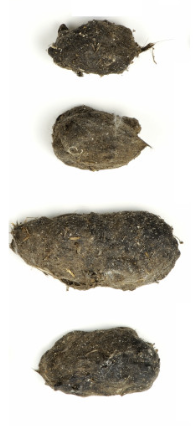
Pellets are not the same as droppings but are similiar they are to get rid of food they can not digest. The pellets have not gone through the digestive system, they come out of their mouth. Barn Owl pellets are usually very uniform in colour. They are Black when fresh and when drying turn grey. Some other birds produce grey pellets but none of these are black when fresh. They are also composed of mainly hair and bone and virtually have no smell.
Droppings (faeces)
Barn Owl faeces are watery and predominantly white, although they can be black or black and white. They are sometimes seen as streaks on wooden roof beams, as splashes on the floor, small white patches on bales, on machinery, or in fact on anything that is underneath where the birds roost or perch.

Nest and roost debris
You can get a nest debris (compacted which has been compacted. Pellets aren't easily seen and lost in the nest) or a roost debris (collection of pellets posited underneath a roost. This has little compaction and the pellets will be visible).
Feathers
Adult Feathers
- You can find both body and wing feathers in building, tree cavities, or nestboxes.
- You can get very small fluffy feathers from the body. These are typically white (sometimes grey) with a tiny quill.
- larger feathers that come from the underparts are generally white. Upper body feathers have the classic golden hue with grey markings although the lower part of the feather is usually white.
- Wing feathers are moulted systematically over a number of years.
- Females tend to moult between May and August, whilst males usually start moulting in July and finish around October. If you find moulted feathers at a site, it’s fairly safe to assume the site has been occupied over the summer months.
Males
Females

Nestling Fluff
Unlike the very small fluffy body feathers from an adult Barn Owl, nestling fluff or down is a temporary feather extension so it has no quill. It’s generally less dense, with a sparse wispy appearance. In the photo shown, the top row shows small adult body feathers and the bottom row shows nestling fluff.

Dead Barn Owls
Just because you find a dead Barn Owl does not mean that the site is no longer occupied. These might be dead owlets. Owlets may be covered in fluffy down, or if feathered, may have downy extensions still present on the feathers.
Small mammal remains
If you find a freshly dead small mammal on a Barn Owl nest debris in early spring then you can be quite certain that a Barn Owl left it there and that it was probably thinking about nesting. Food items can be present in the nest, or just outside, at any stage of the breeding cycle. Most Barn Owls, even unpaired ones, probably cache food at some time in the run up to the breeding season. Older remains of small mammals, particularly numerous bones, are a strong indication that Barn Owls were present. This is because Barn Owls are the only (likely) owl species that does not digest any of the bone it swallows.
